that is, Anno Domini 1355 ac Innocentio Sexto.
On the lintel of the door is the Cross of the Teutonic Order, whose chevaliers set it there. From the door a rock-cut path leads to the Fount of St. Quirinus, shrined and adorned; another chapel near contains an old carved wooden group, three virgins seated on a mule, the central figure wearing a bandage on her eyes. These, as at Vianden and Trois Vierges, are the three Hecates, Trivia, Triceps, and Tergemina; or the three Norns; or the three Christian Graces. A round rock-cavity in the old chapel, with a gutter leading to a square hewn basin, served once for sacrificial altar and blood-conduit.
This claims to be the country's oldest sanctuary. To St. Quirinus' Spring since the tenth century have come pilgrims, every Fourth Sunday after Easter, drinking of the water and bathing eyes therein with mass and prayer, and hearing sermon from the pulpit in the rock. The stone frontal of the altar is as old as the pilgrimage. I ponder amid these rocky walls with their warm and velvety tints, their pied greys and russets and fawns and olives, by the clear stream-side, upon the rites, strange and dark, which here had place in the sacred wood that shaded this spot before the coming of the Saints; when of a sudden the sweet sound of the bell stirs me, and looking through the rusty bars of the screen into the chapel's darkness, 1 see by the quivering light of tapers the people prone upon the earth, an aged priest uplifting the Host above his head. In this Catacomb of "Sanct Grein" the pure Victim has prevailed.
Luxembourg is on the high-road from Ostend to Basle. Yet how many of us know what happens there on the Sunday before Ascension Day, or have heard of Our Lady of Luxembourg? In 1666 the town, beset with grievous troubles, chose the Blessed Virgin solemnly as its Patron. She was entrusted with the keys, wrought in gold; clad in cloth of gold and precious stones; decked with a crown made of the jewels of the Princesse de Chimay, wife of the governing representative of Spain, to the value of nearly ten thousand pounds; and carried in procession through the streets with mysteries and mummeries of the strangest. This pomp was repeated yearly until the French Revolution...
The great occasion at Luxembourg is the annual fair, the Schobermesse, on the twenty-fourth of August. That this Kermesse was instituted by John the Blind [John of Bohemia] in 1340, and that it was in old times a matter of immense importance, is authentic history. But the origin of the name is obscure. The two most likely conjectures are Schober-Messe, Tent-Fair, and Schadbare Messe, Disastrous Fair.
The story is that the news of the loss of Crecy and the death of the beloved John of Bohemia reached Luxembourg as the Fair of that year was commencing. The tidings caused such a panic of sorrow that the merchants who had flocked into the town from other countries were obliged to pack up their tents and depart without having sold anything whatever.
But the modern Schobermesse is very far from recalling so doleful a Feast of Tabernacles; for man and beast, master and servant and maid and horse and ox and ass are decked out bravely with flowers and ribbons, the houses are in full fig of blossom and bunting, and harmony blends with nois« — without suffering by the commixture.
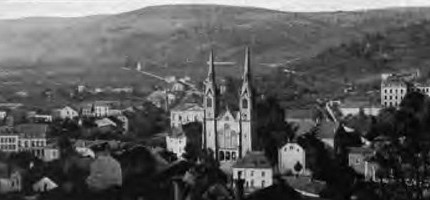 Diekirch, c.1905 Diekirch, c.1905
To tell the years and feel the pulse of Diekirch [Dikrech] town you had best mount the right bank of the Sûre to the edge of the wood that fringes the hill called Hart. Here, on the wood's margin, like a forest-guarding Titan, stands the Celt megalith known as Deivelselter, the Devil having left upon it the mark of a cloven-foot. Its great stones, according to constant tradition, formed once the altar of Dido or Dide, not Æneas' friend, but a Celtic deity, grand-daughter of Odin and niece of Thor. After her, they say, the town was called Didekirch. "Quidam enim Didonem eo loco olim in magno cultu fuisse, atque ibi magnificam aram seu templum habuisse ratiocinantur. A qua videlicet dea oppidum Germanico idiomate Diekirch Didonis quasi templum nominatur." Thus the Abbe Bertels.
On the other side it has been urged that the Druids used for their temples not buildings of stone, but groves; and that Diekirch, as containing the oldest church in Ardenne, the resort of Christians from far and near in the days of the first preachers, was Die Kirche — the church par excellence. This theory is ingenious, but unconvincing. Unbroken local tradition, tending the other way, counts for much; so too does the name of the mountain at whose foot the town is built — Herrenberg, or Thorenberg in old documents, the Lord's Mount, or Thor's Mount.
This massy hill teems with shreds of the old Germano-Gallic faith ; on its top, nearly five hundred feet above the Sûre — whence, standing as on a perfect green globe whose sides fall away all round you into emptiness, you may turn upon your heel and count five-and-twenty sparkling villages — there bubbles an exultant spring, perennial, laughing silverly at droughts, which in old war-days filled the fosses of Diekirch after spinning the common town-mill ; now it leaps fountain-wise in front of Mr. Nelles-Heck's hotel. This rivulet is called Bellenflesschen, from Belenus, Baldur, Belus, Baal, call him what you will, the Sun-god of all faiths, who appears again in Behlenberg and Behlenhof, and probably in Bollen-dorf, the old Villa Bollanae.
Back to the old towering cairn on the Hart-slope. Like many another veteran, it fell in 1815 — "as the weather pleased". Old people can give an idea of its general appearance before that date, having had it from their fathers. Local antiquarians have set it up again, after such accounts and old drawings; yet I do not feel sure whether Odin's grand-daughter, could she come back, would recognise her shrine.
It now appears as a rugged, gigantic, narrow menhir some twenty feet high, built in two piles, having five great hewn stones in each pile, and two immense blocks on top; on the ground are diagonal avenues of recumbent stones. Like Stonehenge and other Druidic work, it is heliometric. Stand facing its arch at summer and winter solstice, and look through; you will see, precisely between the pillars, the rising and the setting sun. If the arrangement be not archaeologically above suspicion, as a rockery it is superb. The protective dignity with which it looks down upon Diekirch brings the millenniums home to one's fancy, standing haughtily as it does upon the very edge of the forest; but move away a few hundred paces, and its sad grey fades into the green, is lost to the eye.
I notice that upon its topmost edge, from out the bare grey stone, as though no empires had risen and to dust returned, there blooms a solitary little blue flower. Nature minds beautifully her own beautiful business. Her "sleepless ministers move on, Labourers that shall not fail, when man is gone." Still, the red-white-and-blue town looks anything but evanescent on this gentle breezy day. Diamond-shaped it is and diamond-bright, set in its arriere-plan of little green valleys that intersperse the feet of its possessive hills — Herrenberg, Kaleberg, Seitert, Schutzenberg, Goldknapp, Bamerthal; Kahlenberg from the left down-sloping into its lap, on the right Herrenberg's more rugged imminence, in front the two-bridged river, bright as glass, rounding it in with a complete, looping curve...
But what were Diekirch without Monsieur Nelles-Heck, the excellent landlord of the Hotel des Ardennes? M. Nelles is a man of wealth, worth and weight. It may be said that M. Nelles is Diekirch. Indeed, he is more. He is the visible presentment of Grand-Ducality. If His Highness Adolf de Nassau be Omnipotent, M. Nelles is his Demiurge. His is a name to conjure with, the Duchy through. In outlying districts the reverential question, "S'qu'y a b'coup d'monde à Diekirch?" suggests Slocum-in-the-Mud inquiring after the Metropole en plein saison.
M. Nelles, who is everywhere at the same moment, keeps a charming house, an unexceptionable cellar, and enough of the good old "mine host" spirit to devote himself personally to every one of his guests, even though his hospitable roof-tree should overshadow above two hundred brethren at once.
In no English country-house have I felt more individually welcome. Formality is none, merely to be present is an universal introduction, liveliness and laughter reign. Quiet is unknown; but as the desire of quiet is an exclusively British trait, that, where our countrymen are in a small minority, does not matter. Among the German, Belgians, French and Dutch who flock to M. Nelles' genial board, I have many good friends. As to the English contingent, that usually consists of a "General" or so...
The dancing in the evenings when the big tables are cleared away, the polyglot flirtations, the strolls in the river-girt garden of moonlight and roses, endear this resort to youth and maid. The Dutch damsel, to my mind fairest of women after the English, is to be met with here...
|
The New York Times, December 15, 1870:
The Luxembourg Question.
In 1867 France and Prussia were on the brink of war, having for its object the possession of Luxembourg. France wanted to purchase the Grand Duchy with its area of 990 square miles, and proposed incorporating its two hundred thousand inhabitants, without asking the consent of anybody save its titular Grand Duke, the King of Holland. The majority of the Great Powers who had guaranteed the neutrality of this territory were perfectly willing that a rather loosely-worded treaty should by this means be removed from the list of international obligations.
Prussia had just then finished her little difficulty with Austria rather more promptly than the French Emperor expected, and had placed herself at the head of the North German Confederation. The King of Holland thought fit to apprise his august neighbor at Berlin of the transaction which the Cabinet at Paris was extremely anxious to smuggle through with all convenient speed. There is every reason to believe that Count Bismarck was well aware of the scheme of his friend at the Tuileries with regard to the Duchy. It is even probable that its peaceful acquisition was one of the conditions made between the two arch conspirators, during their frequent walks on the sands at Biarritz, as the price of the neutrality of France during the Austrian campaign of 1866.
The effusive frankness of the King of Holland was the means of bringing the matter before the North German Parliament, and that body, then in the early glow of its Pan-German patriotism, vowed that Fatherland would go to war rather than an ancient Diet should be absorbed by their traditional enemy.
Nothing loth to find a decent pretext for getting out of an awkward verbal engagement, Count Bismarck protested that he found events too strong for him, and a Conference was assembled in London in May, 1867 to endeavor to avert the struggle that appeared imminent between France and Prussia.
In point of fact, neither Power was quite ready to fight, or the Conference certainly would never have been assembled. Prussia had a rather higher opinion then, of the French military strength than she has today, and France was not altogether prepared to cope with the needle-gun. It was made, nevertheless, a standing reproach against the Emperor by such Frenchmen as Girardin, that he allowed the opportunity to slip of entering on what was then felt to be an inevitable struggle, and of allowing himself to be so completely outwitted by the more astute Brandenburger. Taking everything into account, it is not too much to say that Luxembourg was the proximate cause of the present war.
The Conference of London framed a treaty which was a very explicit, but very useless, document. It was signed on behalf of their respective Governments by the representatives of Austria, Russia, Prussia, France, Italy, Belgium and the Netherlands. Under its provisions the Prussian garrison who had up till that time occupied the town of Luxembourg as a Federal fortress, evacuated the place, its defenses were razed, and the Grand Duchy, under the collective guarantee of all the signatories except Belgium, herself a neutral state, was declared to "form a State perpetually neutral."
An after question was raised about the precise meaning of the neutrality clause of the treaty, which elicited the official declaration from Russia and England that they understood it merely as a "joint guarantee, and not involving the obligation for any of the States to enforce such a guarantee individually." This lucid explanation, of course, rendered the treaty, for all practical purposes, so much waste paper, and will render its present abrogation by Prussia a matter which need not necessarily form a casus belli.
That there is a manifest destiny in the annexation of Luxembourg to Prussia a glance at the map will readily show. Her evident determination to hold Alsace and Lorraine renders Luxembourg indispensable for the proper rectification of the frontier.
|
|