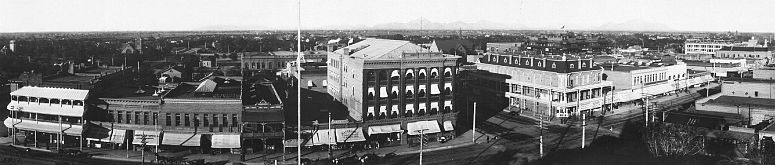
History of Arizona, Volume 6 by Thomas Edwin Farish, 1918, p. 99-103:
CHAPTER V.
EARLY SETTLEMENTS—PHOENIX AND VICINITY.Location Of Phoenix Townsite—East Phoenix—
First County Election—West Phoenix Chosen—
Early Settlers—Sale of Town Lots — Hayden's Ferry, Now Tempe...
According to Mr. Neri Osborn, the Phoenix Townsite was located in the following manner:
"Bill Osborn and Barnum took out a ditch in 1868, and afterwards took out the ditch known as the Salt River Canal north of Phoenix, which irrigated some of this land from the north, that is, where the present site of the city is. They took the ditch out, but Barnett & Block farmed the land, where the town was first located, at East Phoenix, or Mill City.
"A man by the name of McKinnie owned it. There were some old ruins there, and McKinnie and Alvaney built a building there, a two-room building, and started a saloon and a small eating-house.
"Old Tom Farley used to run a restaurant there in 1870, and Hancock and Mowry came down from Fort McDowell and started to build a town there. The old foundations are there yet, and Johnnie Moore owned the place right west at the time.
"He wanted to give them forty acres for a townsite, but father (John P. Osborn), always contended that forty acres was not enough, and told them that three hundred and twenty acres should be set aside for the townsite.
"In the fall of 1870 a meeting had been called at the foundation of a store which had been laid one and one-half miles east of Phoenix by Jim McKinnie, John Alvaney and Captain Hancock.
"The meeting was called for a certain Saturday. On the Friday preceding the called meeting, father and I visited the present site of Phoenix to get a load of wood. We found two men quarreling over the quarter section which lies directly east of Center Street.
"Father asked the men why one did not take the quarter in dispute, and the other the quarter adjoining to the west. This proposition was refused by both, and it occurred to father that the two quarter sections would make an excellent townsite, and, after a little coaxing, the parties to the dispute agreed to quit claim their right, title and interest to the quarter section upon the payment of twenty-five dollars to each on the following Monday.
"At the meeting, the following day, the fifty dollars was raised by popular subscription, and what is now the thickly settled portion of Phoenix, worth millions, was surrendered for a pittance. Maricopa County had not yet been organized. It was a part of Yavapai; and the Probate Judge of that county transacted the necessary work to make the townsite transfer legal.
"W. B. Hellings located his store and mill on Section 1, because there he could get more ground. He bought in there and started the town which was called East Phoenix, put up a mill and a store, and said he was going to start a town there.
"Jack Swilling was interested in that section, and he worked very hard to have the county seat given to East Phoenix. At the first county election, in May, 1871, they nominated for sheriff from East Phoenix, Jim Favorite; and for sheriff from West Phoenix, J. G. Chenowith. They had two tickets, East Phoenix and West Phoenix. This election was for county officers.
"Jack Swilling was married to a Mexican woman, and he had control of the Mexicans, and there were more Mexicans than white men. John Dennis and some of the boys put up a job on Swilling, and switched tickets on him, and all the Mexicans voted for West Phoenix. This decided the election in favor of West Phoenix.
"The campaign was a bitter one, and toward its close Chenowith, candidate for sheriff of West Phoenix, and Favorite, candidate for sheriff of East Phoenix, quarreled, and Chenowith killed Favorite. Chenowith was acquitted but retired from the race.
"East Phoenix put up John Moore, and West Phoenix, Tom Barnum, and the latter became the first elected sheriff of Maricopa County.
"The first interment made in the city of Phoenix was that of a man 'who died with his boots on.' Captain Hancock was the first sheriff, but he had been appointed to hold, the office until the election was held.
"'Lum' Gray settled here in 1868. Ben Peterson and his wife came in at the same time; they came together, Mrs. Peterson and Mrs. Gray. I think they were the two first white women here. Barnum came at the same time that Peterson did. Mrs. Barnum, my sister, came in 1869, at the same time my father and Bill Osborn, Alsap, McKinnie, and others came in. That was in the spring of 1869. When I came in in 1869, there was 'Lum' Gray, his wife, Ben Peterson and wife, Rogers and wife, and Mrs. Barnum. They were the only white women in the valley; only four of them.
"Right after we came in, old 'Coho' Young and his family moved in. Then that fall the Murrays came; Old Man Murray and seven daughters; his wife was dead, and the daughters were all grown up."
After the purchase of the two quarter sections of land for the townsite of Phoenix, Captain Hancock surveyed the land, the town was laid off, divided into blocks and lots, and the selling of the same commenced. The Prescott Miner, in January, 1871, notes the sale of town lots in Phoenix in the preceding December, sixty-one lots being sold at an average price of forty-eight dollars each.
Judge Berry, of Prescott, bought the first town lot, paying therefor the sum of one hundred and sixteen dollars. This property is now occupied by the Dorris Grocery Store on the southwest corner of First and Washington Streets. By this time, 1871, there was quite a population around Phoenix, probably five hundred persons.
This was the beginning of a settlement in the deserts of Arizona which, at this writing, 1918, has developed, into a city of 30,000 people, with all modern improvements, paved streets, electric lights, electric cars, large business houses, and banks with deposits aggregating over ten millions of dollars, in the heart of a valley where two hundred thousand acres of land are under cultivation, with annual products approximating twenty millions of dollars, and which is only the beginning of, perhaps, one of the richest and most prosperous communities under the American flag.
A settlement [Tempe] was also started on the south side of the river at what was then known as Hayden's Ferry. The first canal taken out there was projected by Swilling and his associates, and was completed about the year 1669. Charles Trumbull Hayden located there about the year 1870; also Captain Sharp, Winchester Miller, Niels Peterson, and other pioneers of the South Side...
|